Bavella Needles.
Seven granite towers above a pass at 1,218 metres, signposted here as the Aiguilles de Bavella. This is vertical Corsica — and it is also, of all the places we describe here, the one whose opening is never guaranteed in advance.
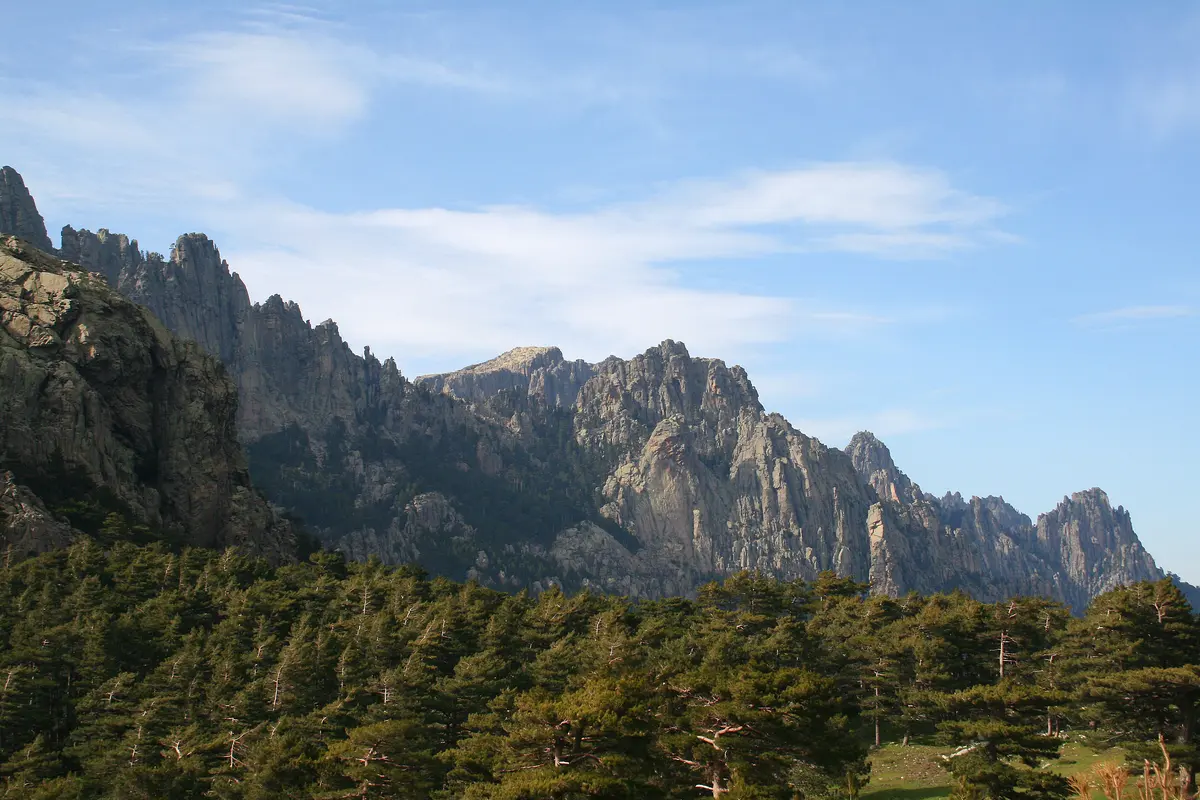
Seven towers above a pass
The Bavella pass stands at 1,218 metres and links the Alta Rocca to the eastern coast. It is crossed by the D268 departmental road, which joins Solenzara to Zonza. At the pass, a statue of Notre-Dame-des-Neiges stands on a stone platform.
The needles are a group of seven granite towers, the Asinau towers — furchi d'Asinau in Corsican. The Corsican tourism agency publishes their heights: Punta Alta rises to 1,855 metres, Punta Iolla to 1,848, Punta Longa to 1,836 and Punta di a Vacca to 1,611. The surrounding massif reaches 1,899 metres at Punta di u Furnellu, and Monte Incudine, which dominates the whole region, 2,134 metres.
The rock is a hard alkaline granite, cut by the alternation of frost and thaw into jagged ridges: serrated peaks, great rock faces and pines twisted by the wind. The forest is dominated by laricio pine, mixed with holm oak, ash and maples. The landscape unit of the massif spans ten communes — Chisa, Quenza, Zicavo, Solaro, Aullène, Serra-di-Scopamène, Sari-Solenzara, Conca, Zonza and Cozzano.
From the estate
- Distance
- 50 km
- Drive
- 58 min by car
- Commune of the site
- Quenza, Corse-du-Sud
- Road
- D268 departmental road, between Solenzara and Zonza
This is a mountain-pass road: the time given is that of an unhurried drive. The Alta Rocca tourist office sums up the useful geography in one sentence — you go from the beaches of Solenzara to the heights of Bavella in under an hour. Planning a full day rather than half a day remains the wiser course.
Walking: two levels not to be confused
The GR20 crosses the pass. From the Asinau refuge, at 1,536 metres, two routes come down to it: the classic line, waymarked in red and white, skirts the needles to the west through the forest; the alpine variant, waymarked in yellow, crosses the heart of the massif by the Bocca di u Pargulu, at 1,662 metres, with chain-equipped sections. South of the pass, the stage continues to the Foce Finosa, at 1,206 metres, then the Paliri refuge, at 1,055 metres, and finally Conca, the southern end of the GR20.
The reference short walk is the Trou de la Bombe (“the bomb hole”), U Tafonu di u Cumpuleddu in Corsican: a tafone, a circular cavity about eight metres across carved out by erosion, near the Punta Velacu, at 1,483 metres. The Alta Rocca tourist office describes a “very accessible” loop through a laricio pine forest, but adds that “the approach to the Trou de la Bombe is tricky”; the eastern Corsica tourist office rates it as moderate, starting from the pass, on the red GR20 waymarking and then a marked path.
We give no time, no distance and no ascent: the two tourist offices responsible for the area leave those fields blank on their own factsheets, and the figures circulating elsewhere contradict one another. The technical details are to be asked of the Alta Rocca tourist office, on +33 4 95 56 06 11.
One confusion comes up again and again: the Trou de la Bombe and the alpine variant of the GR20 are not the same terrain.
The second requires the use of hands and includes equipped sections. Choosing one while believing you are doing the other is the classic mistake in this massif.
What is closed or restricted
Three restrictions are in force in the area, and two of them apply to routes that are regularly recommended elsewhere.
The Purcaraccia canyon. Access is strictly prohibited to anyone not accompanied by a qualified professional from 1 June to 15 October 2026, by prefectural order no. 2A-2026-05-29-00005 of 29 May 2026 (position as at 23 August 2026; the order in force can be checked on the Alta Rocca regulation page linked below). A visit is only possible in the company of a sports instructor qualified in canyoning and holding a valid professional card. Introduced experimentally in 2021, the measure has been renewed every year since. The official grounds are a steep access path, neither waymarked nor made safe, a bathing area sitting at the head of a very narrow and slippery waterfall, a high number of accidents with frequent rescue call-outs, and three deaths in 2021 and 2022. Tourist pages still describe the access route without mentioning the ban: that is no reason to go up alone.
The Piscia di Ghjaddu waterfall. The final section of the path is closed to the public by municipal order no. 2024-064, because the safety equipment has deteriorated (position as at 23 August 2026). The trailhead is in the commune of San-Gavino-di-Carbini, the very commune where the estate stands, and it is one of the most frequently recommended walks in the area: the waterfall cannot today be reached lawfully by that path.
The Casteddu d'Araghju. Access to chamber 3 of this fortified site, in the commune of Porto-Vecchio, has been prohibited since 10 April 2026 by municipal order, because of the risk of falling stones and unstable walls (position as at 23 August 2026).
The massif can be closed — it happened two summers running
On 6 July 2025, faced with the fire risk, the prefecture of Corse-du-Sud prohibited travel by vehicle, by bicycle and on foot, as well as agricultural and forestry work, closing the RD268 with a diversion via the RT 10 and the RD 368. On 17 July 2026, two further orders closed the Bavella and Illarata–Taglio Rosso massifs from 18 July; Bavella reopened on 20 July.
In July and August, then, the site's opening is never guaranteed in advance. The sensible habit, the day before setting off, is to check the news pages of the Corse-du-Sud prefecture and the natural sites regulation page of the Alta Rocca community of communes, where the orders in force are published.
In winter, the D268 and the pass can be snow-covered or icy, and crossing the passes may require winter equipment or be prohibited during snowfalls. The state of the road network is published by the Collectivité de Corse.
Parking
A chargeable car park, known as the Bavedda car park, is operated at the pass. It is seasonal, and the two official factsheets disagree on its period: one gives an opening from 1 July to 31 August, the other simply states that it is not open all year. Enquiries are taken on +33 4 95 71 40 16.
Other organised areas serve the massif: the Ponte Grossu reception area, at the entrance to the Solenzara valley; the Arghjavara reception area, in the massif itself, on a voluntary contribution basis; the Viseu car park; and the Piscia di Ghjaddu area, in the Ospedale forest. Informal roadside parking has been removed in favour of these areas: it is one of the visible effects of the flow management undertaken since 2021, alongside the access limits on the Purcaraccia canyon.
Here, the water is a river
Do not come to Bavella looking for a beach: swimming here means rivers and mountain pools, and the water is cold.
The Solenzara rises at 1,145 metres north of the pass and runs 22 kilometres to the Tyrrhenian Sea, between the communes of Quenza and Sari-Solenzara. The Corsican tourism agency notes “the clarity of its waters and the presence of natural pools fringed with rocks”, reachable from the road that links Solenzara to Bavella.
On the Cavu and the Solenzara, health monitoring has been in place since the bilharzia cases observed in 2013: each summer, bulinus snails — the freshwater snails that host the parasite — are collected there and analysed. Over the 2025 season, 5,905 snails were examined: none was infected, and bathing was authorised all season on both watercourses. The rivers that are off limits in the area are listed on the Santa Giulia beach page.
What is protected
The massif is a listed site under the law of 2 May 1930 on the protection of natural monuments and sites. The needles also form a special protection area of the Natura 2000 network, under the code FR9410109, designated by ministerial order of 26 October 2004: 1,873 hectares, entirely within the commune of Quenza and in communal ownership. The site is made up of rocks and scree, conifer forest, heath and maquis; it is described as remarkable for its population of cliff-dwelling birds and large raptors, owing to the vast areas of inaccessible cliffs.
The species that justified the designation are the Corsican nuthatch — twenty pairs, the only bird species endemic to mainland France — the Corsican goshawk, the golden eagle, with one pair, the peregrine falcon, with two pairs, and the bearded vulture. On that last one the official record is explicit: the pair has not been seen since 2011 and the territory is vacant. The Corsican mouflon is also reported there.
The massif lies within the Corsica Regional Nature Park, created in 1972, which covers 365,000 hectares and brings together the Collectivité de Corse and 178 communes. Camping is prohibited outside the designated bivouac areas, and bivouac nights on the GR20 must be booked.
Sources
- Atlas des paysages de la Corse, “1.07 — Massif de Bavella” factsheet;
- Agence du Tourisme de la Corse, Bavella Needles factsheet;
- Légifrance, order of 26 October 2004 designating the special protection area, and the standard data form for site FR9410109 (INPN);
- Alta Rocca tourist office, massif factsheet and Trou de la Bombe factsheet;
- Alta Rocca community of communes, regulation of natural and cultural sites;
- prefecture of Corse-du-Sud, news pages and massif closure orders;
- Corsica Regional Nature Park and ARS de Corse, for bivouacking and for the health monitoring of the Cavu and the Solenzara.
Distances and drive times given from the estate are calculated point to point over the road network, from coordinates recorded on OpenStreetMap; they are not estimates.
The two houses currently open
Ô6 · Le Couchant — three bedrooms, in the Oso valley.
Ô1 · L'Aube — five bedrooms, on the same estate.
The other surroundings
Palombaggia beach — the porphyry headland and its coves.
Santa Giulia beach — the sand bar and its lagoon.
The places around the estate are on the surroundings map.
Before setting off
In summer, check that no closure order is in force on the massif; in winter, check the state of the D268.
Booking
The calendar and the real availability of both houses are on the home page.